Saturday, September 29, 2007

Calling Another Top

This article sounds interesting and kinda true. The point is basically that once the masses have caught on - the jig is up. This one speaks specifically about Hollywood's latest - an obsession with hedge funds - and the implication that now hedge funds are doomed.

Hedge Funds in Hollywood: TV and movies have rediscovered Wall Street. Time to sell!

Popular culture, which is created by some of the least business-savvy people on the planet, has always been slow to latch onto business and economic trends. The covers of large-circulation magazines are a good contrary indicator. And TV, movies, and books are even worse.


Perhaps a better indication of not so good things to come, a previously cheerful Goldman Sachs economist has apparently determined that things aren't looking to well after all. Maybe people are finally starting to recognize that the greatest bubble in real estate history is exploding and this is going to have broader ramifications than a bunch of overpriced fake-AAA securities.

Goldman Sachs tiptoeing into the bear camp

Goldman Sachs has abandoned its ultra-bullish view of the world economy, warning of a likely recession in Japan and mounting risks that US property slump could spread to parts of Europe.


And unfortunately for the dollar and the Chinese, they seem to be showing up at the wrong time for the party: China's $200 Billion Sovereign Fund Begins Operations

But then again, maybe this is a new paradigm. Or not.

Tuesday, September 25, 2007

Digesting The Cut

I guess it has taken awhile for me to respond to the news about the Fed's 50 bps cut partially because it is hard to know what the implications of the cut will be beyond the short term pop everyone witnessed over the last week and partially because I was surprised enough to take a step back.

As I mentioned in my response to a comment here not everyone was surprised that the cut was 50 and not 25 bps, and in fact Goldman and Merrill were apparently anticipating such a cut.

I found the earnings announcements last week interesting. I was glad to see Lehman continue to stay ahead of expectations and not just for personal reasons - it is great to see a company that has risen from underdog status among the elites continue to fend off foes. It was also surprising before, but certainly not after, their announcement to see that Goldman outperformed partially by being short subprime and subprime-related credit throughout the summer. I guess it seems obvious that if someone like me can identify that trade that the dudes at GS would be all over it.

I guess part of the reason I am bit surprised that the "put" appears to be alive and kicking is that this means things are really bad out there, and the future opportunity set for our economy does not look good. For all the doomsday lingo I have tossed around here and in person with many of you, I am optimistic that our country will continue to be great - and so it saddens me to see the Fed concede the weakness of the dollar and to openly risk inflation out of what must be perceived as necessity. It seems such a move could only be motivated by a genuine concern that this was necessary to stave off more dislocation in the capital markets.

While the equity markets have flown since, we do not at all appear to be out of the woods on the credit side, and as Bloomberg noted, our neighbors are struggling with the CP market effects even with CAD/USD parity: Subprime Panic Freezes $40 Billion of Canadian Commercial Paper

And there is still a ton of buyout debt out there to be funded. I read something yesterday putting the figure at still over $340B.

Let's hope that the credit markets are satisfied with the Fed's liquidity boost...though I would have to guess that the negative press on this front is likely far from over.

Sunday, September 16, 2007

Next Up: Commercial Paper, Earnings and Buyouts

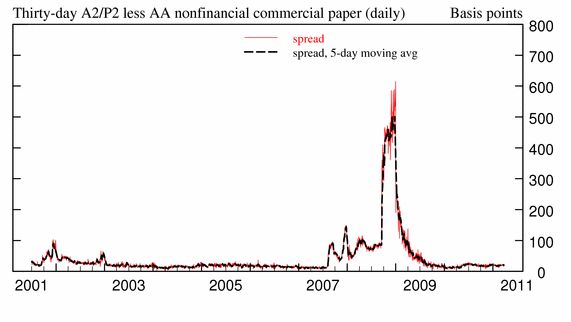
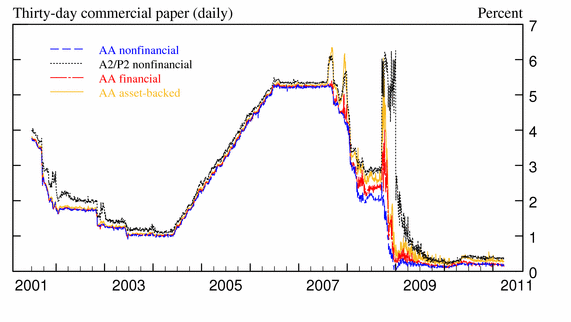
The Commercial Paper market is set to roll over a ton of debt over the next couple of weeks. According to this blog quoting newsweek:

The shaky U.S. credit markets will face a critical test over the next few weeks, as companies try to find buyers for hundreds of billions of dollars in short-term debt that is set to expire. Corporate borrowers are expected to struggle in refinancing their debts, and the repercussions may go far beyond the companies in question. ...

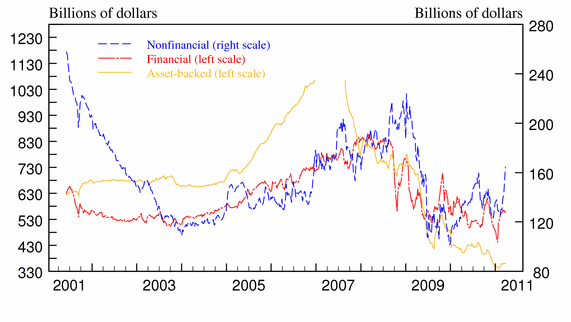
The tightest squeeze may come in what's known as the asset-backed commercial paper market. ... About $417 billion worth of asset-backed commercial paper is scheduled to come due during the weeks of Sept. 10 and Sept. 17, or about half of the $959 billion market, according to Sherif Hamid, an investment-grade credit strategist at Lehman Brothers.


I think these images from the Fed, speak for themselves.


This in the midst of a week where big banks are trying to market billions of buyout debt and BSC, GS, LEH, and MS all announce earnings.

Could be a choppy week indeed. I am investigating SKF and IAI as a way to express a view.

Friday, September 14, 2007

The Power of Numbers

To tip my hand and show, contrary to what the previous post may indicate, that I believe numbers have power - if nothing more they add content to our intuitions and reason.

This is truly one of the coolest displays of statistical data I have ever seen. It also reveals some unintuitive but right-sounding observations about the development of the "Third-World" over the last few decades.

If you have a few minutes, give it a watch:


But don't take it too seriously:

Statistically Speaking

It may be the fault of my Econometrics professor in undergrad who talked about how he enjoyed single malts and parties in his undergraduate days while laughing about "statistical significance." He introduced me to EconoMagic.com, and the glint in his eye as he emphasized the latter half of the site's name coupled with the ease with which I always been able to "massage" the data likely both contributed to my skepticism.

So when I saw this article today, I couldn't help but smile:

Most Science Studies Appear to Be Tainted By Sloppy Analysis

The point of the article is clear from the title - those of us who groan every time someone says "they have proven _____" fill in the blank - are now not only backed by Taleb-like Fooled By Randomness talk, but also an article in the Wall Street Journal about research by a serious scientist.

The irony is of course obvious. Statistically proving that scientists are statistically irresponsible is just kind of funny to me for some reason.

I guess I just feel like more often than not we - scientists, economists, investors, researchers, theorizers - are wrong more often than we are right. Its just really hard to predict the future or come upon anything like the "truth".

That doesn't mean we should give up trying. But when Goldman's Global Alpha gets hammered a few months in a row and Greenspan admits that he saw the Subprime risk but couldn't translate it to a market reaction, it makes one wonder how much we really know about stuff as simple as the capital markets - much less important stuff like science.

Batter up for predicting the next move in the markets...my guess is we have only heard the first of a many shoes (or statistical gaffes) to drop.

Wednesday, September 12, 2007

America The Beautiful

I have always been patriotic. And I am from Texas.

Those two facts are probably correlative and maybe even indicative of causation, but like so many things it is hard to know whether causation exists.

The reason I bring it up is that sometimes I think my pessimism about the markets can get muddled with the rest of the anti-American crap bouncing around out there in cyber-space and the media.

Let me be clear, quoting Taleb's recent article: The Birth of Stochastic Science.

I am convinced that the future of America is rosier than people claim...

It fosters entrepreneurs and creators, not exam takers, bureaucrats or, worse, deluded economists. So the perceived weakness of the American pupil in conventional and theoretical studies is where it very strength lies — it produces "doers", Black Swan hunting, dream-chasing entrepreneurs, or others with a tolerance for risk-taking which attracts aggressive tinkering foreigners.


I think this country is in the process of a splintering dichotomy. On the left-coast (and in cyberspace throughout) the country and innovation is booming at an ever increasing clip. This is primarily being driven by the increased capacity for the consumption and distribution of content that is now mainstream through the internet and mobile devices.

This amped-up connectivity has spurred a whole army of innovators and creators, from simple blog-applications like the one I am writing on, to cool connectivity sites like: pownce.com twitter.com iminlikewithyou.com Or the regulars like: youtube.com facebook.com digg.com the I-phone and the Blackberry.

These sites/devices/applications are allowing people to come together to collaborate and share in ways that were never before possible, and this will allow better coordination, experimentation, and ultimately creation.

And of course...on the other side of the country:

The credit markets and the developed financial systems are reeling. They will continue to reel as the ripple effects of too much capital deployed too cheaply on the levered backs of normal Americans continues to play out. I am continually amazed that people even react to mortgage company layoffs like those announced by CFC over the weekend or the worst home sales since 2001.

Mozilo himself (the CFC CEO who literally made more than $700 mm from selling his shares over the last year) has said that he doesn't see a bottom before late 2008. So if the guy who has made so much money from the game and is most incentivized to keep the thing afloat publicly says there is no bottom until late 2008, my money is that it will be at LEAST that long.

I hope he is wrong, but I would be surprised if he is.

But as Taleb says: most of it is random anyway.

So while the old-coast is crumbling, the new-coast is bubbling with innovation, and that makes me proud to be an American.

Thursday, September 6, 2007

CP Market Vol Uncovered

I wonder if this helps to explain some of the ridiculous Vol/illiquidity/drying up in the CP markets over the last few weeks:

Citigroup reportedly has $100 billion in SIVs

Apparantly Citi (and I would be shocked if they were the only dudes who utilized this type of trade) used off-balance sheet structured vehicles to create a kind of carry-trade. They used CP funding sources (with low yields) to buy higher yielding stuff...like maybe CDO's? hmm. nah. Prolly something better than that. I hope.

More Greenspan Banter

This article is awesome. Basically now that Greenspan is out of office, he can hop into the mainstream and be honest.

In his own words from the article: Greenspan Says Turmoil Fits Pattern

"The behavior in what we are observing in the last seven weeks is identical in many respects to what we saw in 1998, what we saw in the stock-market crash of 1987, I suspect what we saw in the land-boom collapse of 1837 and certainly [the bank panic of] 1907," Mr. Greenspan told a group of academic economists in Washington, D.C., last night at an event organized by the Brookings Papers on Economic Activity, an academic journal.


Unfortunately the difference, at least as compared to 1998, is that this crisis is driven by an unwinding of fundamentals across an entire asset-class - real estate finance - that is related to the entire economy. Real estate impacts individuals directly through their homes, businesses through their rents, companies through their office buildings, investors through their holdings, and everyone above through the increased lending rates coming from bank's losses as a result of the implosion continuing in the ABS/CDO/CLO markets.

Next interesting tidbit on the horizon: Some big LBO's are awaiting closing over the next month or so. Big question: Will the banks just take it for the team?

Monday, September 3, 2007

What's Wrong With A Greenspan/Bernanke Put

I am sitting in the bathroom of a hotel room that I paid way too much for at 3 am, because the air conditioning sounds like a garbage disposal and the walls are thinner than vietnemese rice paper rendering the neighbor's conversation a just audible accompaniment to the clang of the window unit.

And for this I blame Greenspan, and whether this madness continues now lies in the hands of his successor.

I am still amazed - shocked and awed if you will - that people are surprised that the credit markets are where they are today. To me this conclusion is as evident as the good looking guy getting the good looking girl in a Hollywood tentpole conclusion.

Following the excesses of the last few years, and in line with history, we are entering a correctionary period.

Blaming Greenspan fully for this result is of course a slight over simplification. Of course Adam Smith and other economists as well as free market advocates like Milton Friedman should get some credit too, but I digress...

Back to this overpriced room and how it and I got here.

In late 2001 and 2002, following the most demoralizing and evil attack that modern cultures have witnessed, the US Economy was in a sorry state and in desparate need of boosting (I mean 9-11 though Enron and its cohorts were also huge downers). So Greenspan did what any good economist would do to rectify the situation - he threw money at the problem and let the invisible hand, through incentives, sort the whole thing out...and sort it, it did.

Over the next few years, as the Bank of Japan used a similar strategy, the Fed dumped a ton of capital into the system, and as any good free market participant is bound to do, financial engineers from NYC to HK jumped into action trying to make those incentives turn into personal profit.

It took a bit of time but within a couple of years a few exciting, and I think predictable, results emerged.

Through fancy deregulated vehicles called Hedge Funds and Private Equity funds, the rich got richer. These investment vehicles were the perfect avenue through which people with money and credit were able to tap into the cheap debt provided by the government. Sure the path wasn't direct, but at base the idea is simple: borrow money for less than you should be able to - pay really smart dudes to figure out a way to "invest" that money (or take advantage of the inherent discount to fair value provided by the fed) - and count on incentives and Math to sort out the rest. And unsurprisingly, it worked. Anyone who reads the business section of the Wichita Times will tell you that hedge fund managers are the new robber barons, but remember, these dudes were always managing and making money for other Qualified Investors (aka dudes who were already rich).

Next result, and this one is the sad and perhaps less predictable one, the poor got poorer. At first this struck me as unintuitive, but with a little thought it started to make more sense. Basically, poverty, or more importantly relative poverty, is measured on a - you guessed it- relative basis. So it isn't so much that the poor got poorer per se, as much as they didn't get as rich as the rest of us. And that makes sense if you think about it. In order to partake in the partay of cheap and free money, you gotta understand how the whole financial game works, and this game is kinda complicated...so unless you have education, I mean money, I mean education...I think you get the rest.

And driving this giant wedge was not only financial juggernautdom, but the good ole US real estate market. Because cheap money not only drives up returns on big bets, but also on small ones, like buying a 19th century house in Nantucket and slapping a sign on the front and calling it a B+B, people all across the country jumped aboard the gravy train.

This one deserves a bit of elaboration because this is where the mess hits home, literally.

Basically, here is how dudes get rich in real estate: borrow money to buy a property, rent that property out, pay back the loan with the proceeds, sell the property hopefully for more than you paid for it originally.

This game is old and frankly simple, which is why lots of not so bright dudes make money in the "real estate business" (full disclosure: I worked in real estate investing a couple of yrs back).

Well what happened when the financial engineers looking to put that massive amount of free money to work intersected with the concept of the American Dream of homeownership would have brought a year to ole Mr. Smith's eye. The engineers enginered a way to structure products in such a way as to make lending to people who wanted to own a home easier. This process, called securitization, has actually been going on long before the current boom, but what happened when money got super cheap was the amount of capital that needed to be "put to work" got to be too big for the traditional structures. And at the other end of the process, the mirage of the American Dream (and the cool trick of DIY real estate investing) became super-duper-alluring-er to people across the country.

So...along came, I know it is getting old but I will just say it once, Subprime Lending! Well, this is a couple of steps removed, but the gist is super incentivized investor dudes paid incentivized engineer dudes for complicated instruments that kinda incentivized dudes said would pay back money from a bunch of incentivized by dream dudes who were lent money by incentivized to lie dudes. Or, hedge fund and other funds invested in CDO's sold by investment banks that were rated by credit rating agencies and basically consisted of a bunch of promises to pay which at base were made by people who bought a house that they could barely afford and were told which loan to take by a mortgage broker who got paid, not for doing credit analysis on the borrower, but rather by convincing said borrower to take whichever loan paid him the highest commission and which loan, as it turns out often had fancy crazy features like "reset rates" or "prepayment penalties" likely because the rich dudes who were investing the money to fund this whole thing had done well to hire smart dudes who knew that such features made the loans more valuable - on paper.

Whew, that is a mouthful, and lots of stuff is going on in there. The point is: people acted as they should be expected to act in a capitalist economy and stuff got out of hand as the structured finance products fueled a real estate boom that dwarfs all other booms in comparison.

And now...

Dudes who bought on a dream that housing prices would continue to rise are screwed.

Dudes who borrowed money with terms in their loans that they did not understand are screwed.

Dudes who structured the products to sell the loans to fund the dreams and the homes are screwed.

...I don't know why she swallowed the fly...(couldn't resist)...

Anyway, you get the point.

But the problem, or at least the one that is getting Bernanke's attention, is that this what I will call "screwed effect" is now threatening to impact the rich dudes, and they don't like that too much.

But unlike the past, before the real estate boom, there is no clearly obvious place for a new flood of capital to go even if Big B were to pull out the Greenspan Card (way to many ironies in that name to call out) and give the rich and super incentivized dudes their "put" with another rate cut.

Will he do it? I don't know. Will it help if he does? Maybe for some but probably not for dreaming dudes and other fringe real estate players - there is only so much someone can pay for a shitty piece of property, even in Nantucket.

All I know is that if he does cut by more than a hundred bps, I am going to buy as many domain names and property that I can in SecondLife and in Wii-land ahead of Adam Smith's invisible hand and the next tidal wave of incentives finding ways to play with free money.

Tuesday, August 28, 2007

Creating Alpha - On The Short Side

For some reason the market doesn't seem to want to admit that the housing market is on a continually downward trajectory and this will continue to impact the broader economy.

I guess it is hard to admit that things got way out of hand and now the economy and those benefiting from the ride will have to suffer a bit.

So on a day when the Dow was down over 275 pts, it seems appropriate to reflect on individuals who have been proactive about finding investment opportunities - on the short side - ahead of and during the current unwinding.

I stumbled upon an interview with Mark Cuban where he discussed a number of topics, including how "the internet is dead".

But what jumped out at me was the criticism surrounding www.shareslueth.com described as:

A site Cuban "launched [in July 2006] with veteran business journalist Christopher Carey, with the stated goal of uncovering waste, fraud, and abuse in publicly traded companies"


Apparently the goal of the company is to uncover publicly traded companies who have misled or otherwise defrauded shareholders, while Cuban and others short these stocks in the mean time.

Some other heavy hitters in the finance industry were recently called out on Bloomberg.com and accused of hiring a "hit man" to investigate improprieties in a stock that they were shorting: Hedge Fund Hit Man Hired by Cohen, Loeb, Sender, Says Insurer

Both Cuban and these hedge fund investors have been accused of proactively seeking to profit from uncovering wrong doing - a type of event-driven arbitrage, where the investor in these cases create the event.

It is unclear exactly what the facts are surrounding these situations; however, even assuming the accusations are true (for what its worth I am skeptical of the Bloomberg piece in particular) the question remains:

Is proactive investigation of impropriety a bad thing?

It seems to me that having highly intelligent and sophisticated investigators out there searching for companies who have been guilty of fraud or otherwise manipulating their financial statements to the detriment of their shareholders is a good thing. Not only are potential perpetrators caught and exposed, but just as CEO's are inventivized to be more honest through the deterrent example of Skilling, so too potential manipulators might think twice next time after seeing these other companies caught in their lies.

And if on a day like today, when the market gets hammered, these guys are strategically positioned because of this hard work - more power too them. That, in my mind, is really alpha.

Thursday, August 23, 2007

What "Efficient" Markets

Yesterday afternoon I experienced the irrationality of the markets first hand both as an onlooker and an emotional participant.

As most of you have probably seen, Bank of America injected $2b of capital into Countrywide, ending a week of speculation about a possible takeover of the company only a week following Countrywide's tapping of its $12b credit facility as rumors swarmed that it was going under.

As the headline hit my blackberry via Pownce - Bank of America Invests $2 Billion In Countrywide - I initially panicked. Although I have almost completely closed my short position in CFC I still had a bit of exposure, and more than the pittance of capital at risk, I was worried that I had been wrong: for me a shot to the ego can be more painful more than a shot to the pocket book and it is even worse when they correlate.

After digesting that reaction and seeing that the stock was up over 20% in after hours trading, I decided to delve in a little further.

As it turns out, BofA basically bought a junky piece of preferred equity with a conversion price at a significant discount to the after-hours trading price of $26/share at $18/share. The math isn't complicated, and as this article explains, the deal was smart for BofA as, they were able to mark-to-market a huge gain and also make a strategic expansion while a major player has their backs to the wall:

Countrywide Gives Bank of America $447 Million Gain

Even with this headline on Bloomberg screens across Wall Street, Countrywide's stock opened up the day up almost 10% (down from its peak of an almost 20% increase overnight)...

But by the end of the day, the luster had worn off and CFC ended flat with the previous day's close.

Even this result seems somewhat irrational mathematically, as the company just gave away 20% of its equity value for a discount to the current stock price - but perhaps different return requirements or something could begin to explain some divergence in the two securities.

In any event, the reactions - both my initial gulp and the market's initial pop - were driven by emotion, rather than reason. And even now the volatility surrounding it makes reluctant to go near this situation...

So the next time someone tells you that markets are "efficient" invite them to play poker and feel confident that at least for that day, you won't have to worry about that saying about the sucker at the table being you...

Tuesday, August 21, 2007

Voyeuristic Happy Moments Rule

This is truly creative and awesome:

ridiculously cool engagement video

Life can be beautiful sometimes.

P.S. the markets were pretty today too.

Monday, August 20, 2007

Finally The Fed Admits: Contained = Contagion

On Friday, the Fed finally did an about face and openly admitted what the entire world had already figured and priced into the global securities markets by suggesting that the "subprime" crisis was not simply relegated to one basket of securities, but rather - it is part of a larger problem growing out of the aggressive lending policies surrounding the boom in the real estate markets over the last half-decade.

As investors scramble to assess just how far this contagion will "spread", typically-savvy fixed-income brainiacs are dumping securities across the board and driving up prices (and down yields) on the only surely safe thing left in the market - US T-Bills: Treasury Bill Yields Fall Most Since 1987 on Money Fund Demand

While this confirms that the Fed finally has it right in suggesting that the problem stemming out of subprime credit and the CDO's and other related securities funding them, it also suggests that the Fed action on last Friday did not address, and perhaps can not address, the shaken confidence of investors who are stuck holding instruments that: 1) are worth less than they thought and 2) have liquidity risk and other difficult to calculate exposures that make them almost impossible to value appropriately in a market like this one.

The always clear and coherent bond guru, Bill Gross, explains in this article that the difficulties were caused primarily by creating complex and opaque instruments that are now finally being undressed. And it isn't a pretty sight:
Tough love on Wall Street
As lenders hunt for bad loans, Pimco founder and Fortune columnist Bill Gross says the Street is learning hard lessons about disclosure.

Putting The Pieces Together

This report does an excellent job walking through the economic indicators that show that the housing market has been both the weight driving the pendulum of the markets up and now down again over the last few years.

Anyone with 20 minutes on their hands who wants some insight into where we are and where we might be headed should give this a read:

Midsummer Meltdown Prospects for the Stock and Housing Markets

"This paper examines the factors that have led to the recent instability in financial markets, specifically the housing bubble and the recent run-up in stock prices. Prices in both the housing market and the stock market are often moved by psychological factors that have little to do with fundamentals.

The paper notes that the economists and analysts who give advice to the public and policymakers are often caught up in the psychology of financial bubbles along with everyone else. "

Friday, August 17, 2007

Revisiting The Indicators

It has been awhile since I posted the beautiful (read: scary) charts of the ABX indices that were the start of all of this trouble:

ABX Indices by Markit

These reflect the reality that has been driving the crisis in the credit markets.

This article does a great job walking through a summary of what has been going on in the underlying real estate mortgage markets. It is a great refresher or intro for anyone:

In a Credit Crisis, Large Mortgages Grow Costly
"When an investment banker set out to buy a $1.5 million home on Long Island last month, his mortgage broker quoted an interest rate of 8 percent. Three days later, when the buyer said he would take the loan, the mortgage banker had bad news: the new rate was 13 percent."

I also discovered these CDX indices for the first time tonight. They show how the woes that started with mortgages have now spread literally across the spectrum of the credit markets (and the equity markets of late):

CDX Indices by Markit

Notice this Emerging Markets chart in particular:


The cost of protecting emerging market debt has almost doubled in the last week or two...one can only speculate about what is driving this particular factor, but I would imagine the "flight to quality" and "unwinding" of positions is to blame.

And the Asian markets continued their tumble overnight. Stay tuned.

Thursday, August 16, 2007

What Tomorrow Brings

The weather analogies continue as the first storm to hit land dissipated much like the huge drop in the market mid-day today.

Now another storm, this time a hurricane, looms on the horizon, and I can't help but press the weather metaphor to the breaking point.

Just as forecasters struggled with fear anticipating the worst hurricane season in history only to see the second consecutive weak season to date, so too doomsdayers (myself included) anticipated a major correction heading into late 2006 and 2007 only to see the Dow hit a record high mid-summer...

Now as the markets seem to be showing sure signs of the crisis we have feared, a hurricane is finally brewing in the tropics - both bring threats of disaster, but hope remains.

Predicting which way it will turn is hard, and as it turns out, apparently even Einstein can be mistaken...as the speed of light may not always predictable according to German Scientists who recently stated: 'We have broken speed of light'

Good luck over the next few weeks...let's hope the storm stalls over cool waters.

Like Rain in Texas

Irony can be ironic: the same day that the first tropical storm of the season made landfall in Texas, the markets have been pouring down on investors across the board.

One of the greatest challenges when trying to understand the financial markets is recognizing that the "price" or "value" of a security is driven by what people are willing to pay for it above all else. This value is driven by 2 primary factors: 1) how the company/asset underlying the security has performed in the past and 2) what investors expect out of the asset/company in the future.

Although the first factor can sometimes be complicated and hard to pin down, it is the second factor that drives price appreciation and today, depreciation.

As the uncertainty of the implications of our over-indulgence in the credit markets looms overhead, investors around the globe are increasing the discount rate of their future expectations - which by definition reduces valuations.

The VIX continues to spike and speculation is running rampant that the Fed is talking out of both sides of its mouth...all of this is like a deluge on the expected values of securities across almost every market.

Predicting the future is hard...especially when it comes to weather and people.

Wednesday, August 15, 2007

Sobriety Can Be Hard

I just returned from a trip to Cabo San Lucas, and I have to say after not a drop - the City looks different when not seen through tequila-laden eyes...

And so do the rating agencies when seen through the reality of the underlying credit rather than the "mark-to-model" numbers that seemed all-so-convincing as recently as May. It turns out that the "ratings" given to the senior tranches of certain CDO securities were more of a mirage than a reality, as the underlying mortgage credit has continued to weaken across the country.

Moody's, S&P Lose Credibility on CDOs They Rated

The last few days have continued the downward spiral that started with these CDO's early in the summer and now is spreading to global equities, as the reality of a deepening world-wide credit crunch is becoming more clear. As I feared in my post last Monday the rebound before the Fed did not move apparently was nothing more than a brief pause on a continuing downward trend.

One of the most surprising data points that continues to be discussed surrounds the massive negative moves in so-called "quant-based" hedge funds over the last couple of weeks.

Goldman, who's funds have perhaps been the most visible of the sufferers, with clear eyes and looking into the midst of the storm, agreed to re-up its commitment to the strategies by committing "$2 billion of its own money" and into one of its losing funds according to Bloomberg:

Goldman Fund Cuts Fees to Woo Investors After Loss

The fact that Goldman is being joined by Perry, Greenberg, and Broad - some of the savviest investors of our time - suggests that perhaps there is opportunity to be had in keeping a level and clear mind in the midst of the recent volatility.

I continue to remain cautious and selective - but I also continue to dive in where clear opportunities present themselves...like enjoying a mexican sunset with open eyes.

Friday, August 10, 2007

The Limits of Expectations

When I first read this doomsday article yesterday, I thought the guy was frankly a bit extreme to say the least:

MBS Monetization and US Dollar


It wasn't only that the graphics atop the page made me hesitate, but I thought that the idea underlying his argument - that "Fannie Mae will eventually become a funnel for monetization, after functioning as a centralized efficient clearing house..." was far fetched, especially when Bush yesterday kept a lid on Fannie and Freddie Mac's capacity.

However, overnight the Fed made such a doomsday picture for the dollar more believable, as it made the writer of this complimentary article eat his words:
Fed Joins Banks Adding Cash to Stem Credit Collapse and Fed Adds $35 Bln in Funds, Most Since September 2001

Some of the figures tossed around in these articles make me begin to wonder whether such an extreme scenario is not that far fetched - particularly when I read that the intent is to provide "reserves to ``facilitate the orderly functioning'' of markets"...in other words to provide an artificial buffer to inaccurate underwriting.

I personally think that the system will not spiral out of control for a number of reasons, maybe the most important of which is that we don't want it to - in other words, investor psychology and American optimism should provide a "floor" of some kind.

However, the second consecutive brutal day in the market highlights that things are not looking pretty right now.

And those who have made heretofore money hand over fist using predictable trends are continuing to struggle as the underlying credit continues to unwind: Market Turmoil Is `Perfect Storm' for Quant Funds

As the article states and I mentioned yesterday, today is a different day: "``Previously uncorrelated factors have recently been falling with the same pace, leaving investors with very few places to hide.''

Thursday, August 9, 2007

Correlation, Causation, and Change

Reality reared its ugly head overnight last night as the Europeans realized that they have some trouble on their hands in the form of U.S. denominated mortgage backed securities.

The equity markets took a pummelling as the beneficiaries of global liquidity (i.e. broker-dealers) faced tougher prospects for an easy out: U.S. Stocks Tumble on Credit Concerns; Banks, Brokers Retreat

Interestingly, at the same time that more bad news emerges around CDO's and other asset-backed pools of securities, many quantitative hedge funds are apparently taking large hits as their statistical models face a changing marketplace: Highbridge, Goldman `Quant' Hedge Funds Lose Money

To me this is unsurprising and driven by the same trend causing the implosion in the CDO markets. Most of these "quantitative" hedge funds are driven by modeling techniques that utilize a high degree of statistical analysis. Statistics is great for telling a story about what has happened and also powerful for picking up potentially unnoticed correlations (and therefore - in theory - causation). However, this power is harnessed and utilized in the context of looking at historical data.

The challenge facing the credit markets and statisticians generally is that things seem to have changed. For whatever reason (I have speculated about many possible theories below), the underlying credit dynamics of the housing market and the surrounding financing markets have had a dramatic impact on the mispricing of risk generally, and now reality is coming home to roost. It is not surprising that as these underlying changes play out, models based on data collected in a different historical context sometimes fail.

Maybe part of the reason why these models don't work as planned is because the system is built on the backs of sometimes not entirely rational creatures - american homeowners.

This article offers an interesting take on why home owners are lured into loans they may not be able to afford: The Psychology of Subprime Mortgages

As the author states: "I think a big part of the reason sub-prime loans remain so seductive, even when the financial terms are so atrocious, is that they take advantage of a dangerous flaw built into our brain. This flaw is rooted in our emotional brain, which tends to overvalue immediate gains (like a new house) at the expense of future costs (high interest rates). Our feelings are thrilled by the prospect of a new home, but can't really grapple with the long-term fiscal consequences of the decision. Our impulsivity encounters little resistance, and so we sign on the bottom line. We want the house. We'll figure out how to pay for it later."

Such a statement sure sounds like it makes sense and is predictable to a human being like you or me. But unfortunately, statistics speaks a different language than common sense...and as it turns out that linguistic gap may have dramatic consequences.

Wednesday, August 8, 2007

Web 3.0 is Real

Whether it will evolve as some combination of a Wii and Secondlife, with Nuance voice recognition technology allowing us to get past the interface hurdle...or simply through next-generation I-phone like devices tapping into social networks like Pownce or Facebook - the next "big" thing seems to be unfolding on the horizon in the internet space.

Check out this video where Google's CEO takes a stab at anticipating where "3.0" is headed.

Bouncing With Beta

Since everyone else is enjoying the ride over the last few days, I figured maybe there is some space for good news.

On globalization front, it looks like DFJ is continuing to expand its global VC horizons by entering into another partnership: DFJ’s Global Offensive

This is a great for the idea that collaboration between entrepreneurs will continue to be enhanced on a global scale which should escalate the pace of innovation.

...and (not) unrelatedly, peaks tend to bring signs of the next movement in global risk premiums. Not sure whether this would ever materialize, but the fact that China is now openly recognizing that they are the 1,000 lb gorilla in the U.S. Treasury market makes one gulp just a tad...then look back to that booming ticker:

China threatens 'nuclear option' of dollar sales

Monday, August 6, 2007

Positive Signs?

Maybe Cramer's cage-rattling was like BX's IPO, in that it indicated the "top" of a market. Hopefully in this case it marked the peak of the hysteria and angst which has driven up the VIX index dramatically over the last couple of weeks as people grappled with the credit markets' unwind.

As a friend mentioned in his comment below, NFI, one of the subprime mortgage lenders to take a plummet last winter and spring, has announced that they are going to resume issuance of subprime loans after the market has been literally frozen over the last few weeks: NovaStar Will Resume Making Subprime Loans

Apparently Novastar disagrees with Indymac, who only last week stated that the secondary markets for mortgage backed securities are illiquid

The market rallied significantly today, led by the same Financial stocks who have been hammered over the last weeks, so apparently some people agree that conditions are changing.

It will be interesting to see if this is sustainable or simply a dead cat bounce before the next round of carnage.

As I have mentioned before, I am selectively diving in on both the long and short side, but cash looks pretty good right about now.

I Hate to Quote Cramer But...

This is just an example of the angst that people feel when reality smacks them in the face. It is almost funny to see someone who as little as two weeks ago was "bullish" freaking out like this...but a little scary:


At least he recognizes that the engine driving this train is the pain being felt by homeowners who are being hammered by the ongoing mortgage-resets.

Unfortunately, I am not sure 50 bps will do much to change anything at this point.

Thursday, August 2, 2007

Transparency is Sometimes Scary

IndyMac (IMB) prides itself on providing transparency to its investors, a beacon in the complex and sometimes confusing financial services sector. (For a primer on the mortgage securities industry visit their webpage's investor relations section and read their investor presentations.)

Following this tradition and a disappointing earnings release yesterday (was anyone surprised?), their CEO went so far as to publicly release the e-mail he sent to his employees explaining the current situation:

Email from Mike Perry, Chairman and CEO: Conditions in the Private Secondary Markets and Their Implications for our Industry and Indymac

I would take a few seconds and read the e-mail if you are interested in trying to understand what is happening in the housing sector, but to quote an important piece:

"Unfortunately, the private secondary markets (excluding the GSEs and Ginnie Mae) continue to remain very panicked and illiquid. By way of example, it is currently difficult, at present, to trade even the AAA bond on any private MBS transaction. In addition, to give you an idea as to how unprecedented this market has become…I received a call from U.S. Senator Dodd this morning who seeking an understanding of “what is really going on and how can I and Congress help?”"

Basically the markets are frozen and no one knows what to do. I also heard from a confidential source that there are issues in the pricing of certain non-real estate related securities in the distressed debt market that people are struggling to figure out.

As major hedge funds hit hiccups, and the market reacts, it is not surprising that illiquid markets become unpredictable. The implications of this could be dire, especially for the real estate market as challenges in securitizations mean harder home mortgage refinancings.

Remember - look at the chart in the upper right hand side of this page - ARM resets are still rising and not at the peak. In other words, at the asset level, the worst is probably still yet to come.

Now, this may not necessarily translate into drops in all markets across the board, especially now that everyone is acknowledging the elephant that has been trouncing around the room. The key question is whether Greenspan is right in that the hedge funds and other sophisticates will find a way to arbitrage away the illiquidity or whether the irrational fear that is creeping into the markets will create an ever growing snowball.

Wednesday, August 1, 2007

Cue the Orchestra

As if on cue, an article hit the screen today foretelling the bubble bursting...and as if responding to my post from yesterday, the author called for a pop of the Web 2.0 bubble.

Bubble 2.0 Coming Soon

I am sticking by my optimistic guns and hoping that he is just a hater and that the frenzy going on at the cross ways of media and technology will continue to boom and generate innovation and valuable new ideas. But the idea that cycles exist is surely coming back into the zeitgeist as the credit and real estate markets wake up from the greatest fiesta in history with the beginnings of an equally epic hangover.

That the party is over for many who were riding short boards along the wave of liquidity is becoming more apparent daily as banks are starting to openly claim that they are pulling back their previously generous open arms: Bank warns hedge funds of liquidity crunch

And other blue chip hedge funds are now publicly taking huge hits Tudor Raptor Fell 9% in July; Caxton's Global Lost 3%

Although this is likely only the cresendo of the coming climax, sometimes people mistake the hillside for a mountain top, and maybe if we concentrate hard enough we can make it true.

Tuesday, July 31, 2007

Metaphors Mix Vision

I am not sure what to think about the fact that a money manager and I have been having the same feeling of "watching a train wreck in slow motion" as the current credit cycle unwinds.

Although I can safely say that he is more bearish than I am, I do agree with the overall sentiment that things will worsen significantly before we are out of this thunderstorm:

Jeremy Grantham: We're Watching A Slow-Motion Train Wreck

But in the mean time, thankfully the creative side of our economy continues to elicit, if not lightning bolts, at least enough camera flashes to distract one from the clouds.

Although the GUI leaves something to be desired, this collection of start-ups confirms that ingenuity and creativity are booming:

KillerStartups.com

The website attempts to use the "digg/filter" model to allow users to sort through the various new startups popping up out there.

I hope the name isn't too ironic or foreboding of another turn of events in the web 2.0 space...I think the credit markets will be dark enough without another bubble bursting alongside it.

Monday, July 30, 2007

Like Dominoes

This article updates the spread of contagion to blue chip fund Sowood Capital Management LP. According to Bloomberg, the NY Times article I referenced below mentioning a drop of 10% is vastly understated, and instead the firm's "two hedge funds plunged more than 50 percent amid the rout in credit markets."

Citadel Takes Over Most Sowood Assets After 50% Loss

As the article also mentions, this fund suffered losses not in subprime loans, but in "corporate bonds and loans". This surely is contagion in its clearest form.

Interestingly, as I discussed in the last post, Citadel, another hedge fund, still has adequate resources to step in and save off total implosion by buying some of the assets. In other words, at least in this case, the system is digesting the distress (albeit at a highly discounted level).

Unfortunately, I don't think this will be the last headline like this, especially given the fact that those at the helm of this fund were former Harvard Endowment managers - aka theoretically some of the best in the business.

CCRM = Be Careful

The below article discusses a recent report by the Fed which focuses on Counterparty Credit Risk Management (CCRM) as a crucial component to reducing the risk of a system wide implosion

Fed Report: Risk Management Best Defense Against HF-Caused Market Failure


In English, this means that you should be careful who you are dealing with, especially when lending them billions of dollars.

Seeing how difficulties in underwriting the credit risk on something as simple as a home mortgage can have massive impacts when magnified to a large scale (aka the recent implosion in CDO's and other mortgage back securities) leads me to wonder how inadequate CCRM - or not being careful enough with your hedge fund counterparties - will impact the balance sheets of prime brokers as the credit cycle plays out.

The NY Times today mentioned that woes are even spreading to blue-chip funds: $3 Billion Hedge Fund Is Down 10% for Year.

This further highlights how challenging it is to adequately implement CCRM in a dynamically changing environment while you are at the same time competing for business.

Finally, it looks as though funds may be feeling the back-lash from this reality setting in as Prime Brokers have started implementing stiffer terms for certain hedge funds: Hedge Funds Feeling the Heat

As with the regulation of subprime lending, closing the spigot too fast could cause greater volatility as the system looks to digest an increasing level of distress...Or maybe this is just enough CCRM to keep things from spiraling out of control.

Friday, July 27, 2007

Naive Optimism

One of the things most unsettling about the current situation in the credit markets is that it makes me question the integrity of the financing system behind the boom in the mortgage securitization market and the financing markets in general.

While this headline may be motivated by an investor's misplaced frustrations, when I see the rapid pace at which the system has unraveled over the last few months, I am inclined to believe that this will be the first of many such accusations:

Wall Street often shelved damaging subprime reports


In defense of the big banks (and not just because I used to work at one and I have friends at many), there is some validity to the concept that each issuance includes the words "past performance is not necessarily an indication of future results" for a reason. It is difficult to know when and how events will change, and people's predictive abilities are massively hindsight biased.

For the same reason that people are more likely to laugh at a joke when the CEO laughs first, individual buyers and sellers in a market are unlikely to depart from historical valuation methods unless someone else moves first. This causes people to move late and then in a herd mentality.

As an underwriter, it is likely impossible to predict the timing of such movements, and if "valuation" is defined by the market's willingness to pay for something, then in a very real sense, until that herd moves you are justified and in fact almost mandated to price things based on historical performance.

In this case, I have no doubt that the rating agencies, as helped by the banks, modeled hundreds if not thousands of scenarios in each securitization transaction. Through these "Monte Carlo" simulations, they felt justified in thinking that the past performance and correlations were sufficiently predictive of future pricing to "rate" the securities accordingly.

As an investor in such a transaction, the onus would then be upon you to question the underwriting techniques - to anticipate future changes...and to perhaps even use a bit of creative thinking to try to predict when the market and herd would move.

Unfortunately, during the financing boom over the last five years, both buyers and sellers lost sight of the reality of a deteriorating credit (the american homeowner) underlying the system.

Now that we are watching the cards fall down and reflecting on some of the bad investments in the rear view mirror, it is only natural to point fingers, and to doubt.

But as I reflect - my naivete wins out - and instead of litigation I reach for learning so that we can perhaps minimize the contagion in this cycle and learn to prevent it next time around.